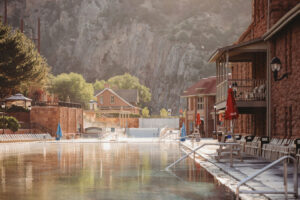
For nearly a century and a half, Glenwood Hot Springs has been drawing people from around the world to its steaming mineral pools set in the heart of the Rockies. Long before Instagram made “destination relaxation” a thing, travelers were making the journey here for something even more enticing — the healing waters of Yampah Spring.
The Ute people, who lived and hunted in these mountains for centuries, were the first known visitors to the site, calling the spring “Yampah” — meaning “Big Medicine.” They understood the value of soaking in the mineral-rich waters, a tradition that would later attract explorers, entrepreneurs, and eventually, a steady stream of vacationers seeking both health and pleasure.
One of those early explorers was Captain Richard Sopris, who in 1860 led a geographic expedition that rediscovered the springs for the wider world. Two decades later, a trio of businessmen — Walter Horace, James Devereux, and a group of British investors — purchased the site along with ten acres of surrounding land. They had big plans. Using the astonishing 3.5 million gallons of naturally heated mineral water that rises from the earth’s core every day at 122°F, they set out to build something extraordinary.
In 1888, they unveiled it: the world’s largest hot springs pool. The town of Glenwood Springs was just finding its footing then, but the grand opening of the resort immediately put it on the map. In the golden age of mineral spas, the Glenwood Hot Springs was known far and wide as the “Spa of the Rockies,” a title it still proudly carries.
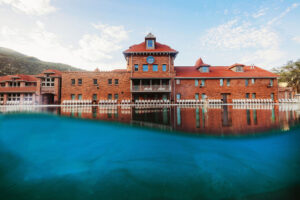
The original red sandstone bathhouse and lodge, built in 1890 for the princely sum of $100,000, was the work of Austrian architect Theodore von Rosenberg. The design was impressive — solid masonry walls, local peach-blow sandstone, and elegant interiors that offered Roman vapor baths, private soaking tubs, a gymnasium, and even a ladies’ parlor. Each of the 44 bathing rooms came with its own dressing and lounging space. Back then, a trip to Glenwood Hot Springs was both a health retreat and a social statement. Aristocrats, political leaders, and Hollywood stars all made their way here, soaking under the same mountain backdrop that greets guests today.
The resort’s history took an unexpected turn during World War II. From 1943 to 1946, the Hotel Colorado and Hot Springs Bath House were transformed into a U.S. Naval Convalescent Hospital, treating injured servicemen. It was the only time in its long life that the hot springs closed to the public. After the war, it served as a private hospital for a few more years before returning to its original purpose — a place where people could relax, heal, and simply enjoy life.
Through the decades, the resort has evolved to meet changing tastes. A 1970 master plan brought in new attractions like a water slide, a children’s wading pool, and miniature golf. The 1986 addition of the 107-room Glenwood Hot Springs Lodge gave visitors the option to stay just steps from the pools. In recent years, the resort has balanced its historic charm with modern updates. The family-friendly Sopris Splash Zone opened in 2019, offering younger guests a fun, water-filled playground. In 2022, the Therapy Pool was redesigned and the changing facilities fully renovated, and in 2024, the Yampah Mineral Baths brought a touch of luxury to the traditional soaking experience.
The latest chapter in its story is Hotel 1888, a boutique 16-room property located inside the historic stone bathhouse, which, along with refreshed Lodge rooms, debuted in 2025. It’s a perfect blend of heritage and comfort, allowing guests to immerse themselves in the hot springs’ history while enjoying the conveniences of today.
Of course, the main attraction remains the pools themselves. The Grand Pool, at a comfortably warm 90–93°F, is big enough for both leisurely soaks and casual laps. The Therapy Pool, kept at a toasty 104°F, offers a more intense mineral bath perfect for easing muscles after a day of skiing, hiking, or biking in the surrounding mountains. Whether you’re floating lazily under a summer sun or steaming in the crisp air of winter with snowflakes drifting down, the sensation is pure Colorado magic.
Beyond the pools, Glenwood Hot Springs Resort offers a full-service athletic club, an on-site grill for refueling between dips, a gift shop stocked with everything from swimwear to locally made souvenirs, and a range of spa services designed to complement the therapeutic waters. It’s the kind of place where you can plan a full vacation without ever leaving the property — though the pedestrian bridge to downtown Glenwood Springs means great restaurants, shops, and other attractions are just a short stroll away.
Still, it’s the intangible that keeps people coming back — the sense of connection to a place that has been a gathering point for health and happiness for generations. Standing in the same water that once soothed weary Ute warriors, dazzled European aristocrats, and comforted recovering servicemen, you feel part of a long, unbroken chain of visitors who came here seeking something special.
For visitors looking to plan their trip, consider exploring our High Country Brochures for local travel guides, brochure distribution services for tourism marketing, or checking out our coverage in the Delta County, Montrose, and Mesa County areas to see where you can find your next adventure.
**Photo Credits go to Andy Neher Photography